What Is Partial Knee Replacement?
The knee has three main areas, called compartments: the inner side (medial), the outer side (lateral) and the area behind the kneecap (patellofemoral). Arthritis sometimes wears out only one of these. In a partial knee replacement, also called a unicompartmental knee replacement, the surgeon resurfaces just the damaged compartment with metal and plastic components and leaves the rest of your knee alone.
Because less of the knee is replaced and the ligaments are kept, many people find a partial knee feels more like their natural knee. The incision is usually smaller, and recovery is often quicker than with a total knee replacement.
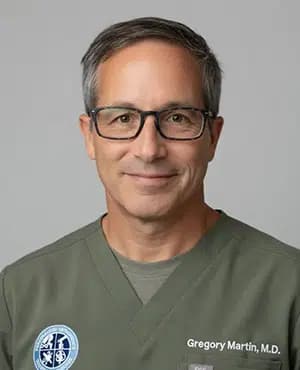
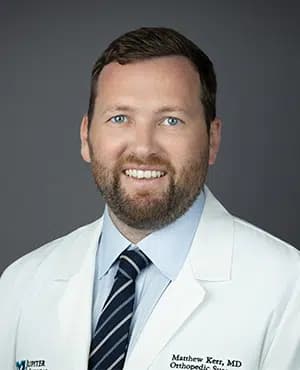
Dr. Martin offers personalized knee replacement, including customized partial knee replacement planned from your own imaging. Dr. Kerr trained on the MAKO, ROSA and CORI robotic-assisted systems, which can help with precise positioning where the facility offers them. Dr. Martin's FASTREC recovery pathway and his P3 concierge program are also available to partial knee patients. His site explains personalized knee implants in more depth.
Performed at a hospital or outpatient surgery center where our surgeons operate, with pre-op evaluation, imaging and physical therapy here in our Boynton Beach office.
Who Is a Candidate?
A partial knee replacement may suit you if your arthritis is mostly in one compartment, your knee ligaments (especially the ACL) are intact, your knee bends and straightens reasonably well, and your knee is not badly bowed or knock-kneed. X-rays in our office, sometimes with standing or stress views, and occasionally an MRI help show whether the other compartments are healthy.
If arthritis affects more than one area, or if there is significant inflammation or instability, a total knee replacement is usually the more reliable choice. As with any joint replacement, our surgeons generally try non-surgical care first, such as physical therapy, weight management, bracing and injections.
What to Expect
Planning starts with an exam and imaging in our office. Our on-site physical therapists can start a pre-surgery program to strengthen the muscles around your knee. Some patients also choose iovera, which uses cold delivered through small needles to temporarily block pain signals from nerves around the knee, as part of their plan before knee surgery. William Ulrich, PA-C, performs iovera in our office.
The operation typically takes about one to two hours under spinal or general anesthesia. Many partial knee patients go home the same day or the next day, depending on their health and the facility. You will usually walk with an assistive device soon after surgery.
Risks and Side Effects
Risks are similar to total knee replacement: infection, blood clots, stiffness, ongoing pain, nerve or blood vessel injury, and anesthesia risks. A specific risk of partial knee replacement is that arthritis can progress in the parts of the knee that were not replaced. If that happens, the partial knee can later be converted to a total knee replacement.
Recovery
Recovery varies, but many people move through it faster than after a total knee replacement. Walking aids are often needed for days to a few weeks. Driving is often possible within two to four weeks once you are off opioid medication and can brake safely. Most people return to everyday activities within six weeks to three months.
Physical therapy continues in our office after surgery, and your therapist shares your chart with your surgeon so your plan can be adjusted as you heal.
Physical therapy happens in our office, with therapists who share your chart. Learn about on-site physical therapy.
Insurance and Cost
Partial knee replacement is usually covered by Medicare and most commercial PPO plans when it is medically necessary. Prior authorization is often required. HMO and managed-care plans need a referral from your primary care physician in our office before the visit. Co-pays, co-insurance and deductibles are due at the visit. P3 concierge membership benefits are not covered by insurance. Call our office and our staff will check your benefits.
When to Talk to a Specialist
Schedule a visit if knee pain on one side of the knee keeps you from walking, climbing stairs or sleeping well and has not improved with non-surgical care. After surgery, go to the emergency room or call 911 for fever, spreading redness or drainage from the incision. Call our office the same day about new calf pain or swelling after surgery; if you cannot reach us, go to the emergency room. Call 911 for sudden shortness of breath or chest pain.